
Virtual Research Environments (VREs)
What is a VRE?
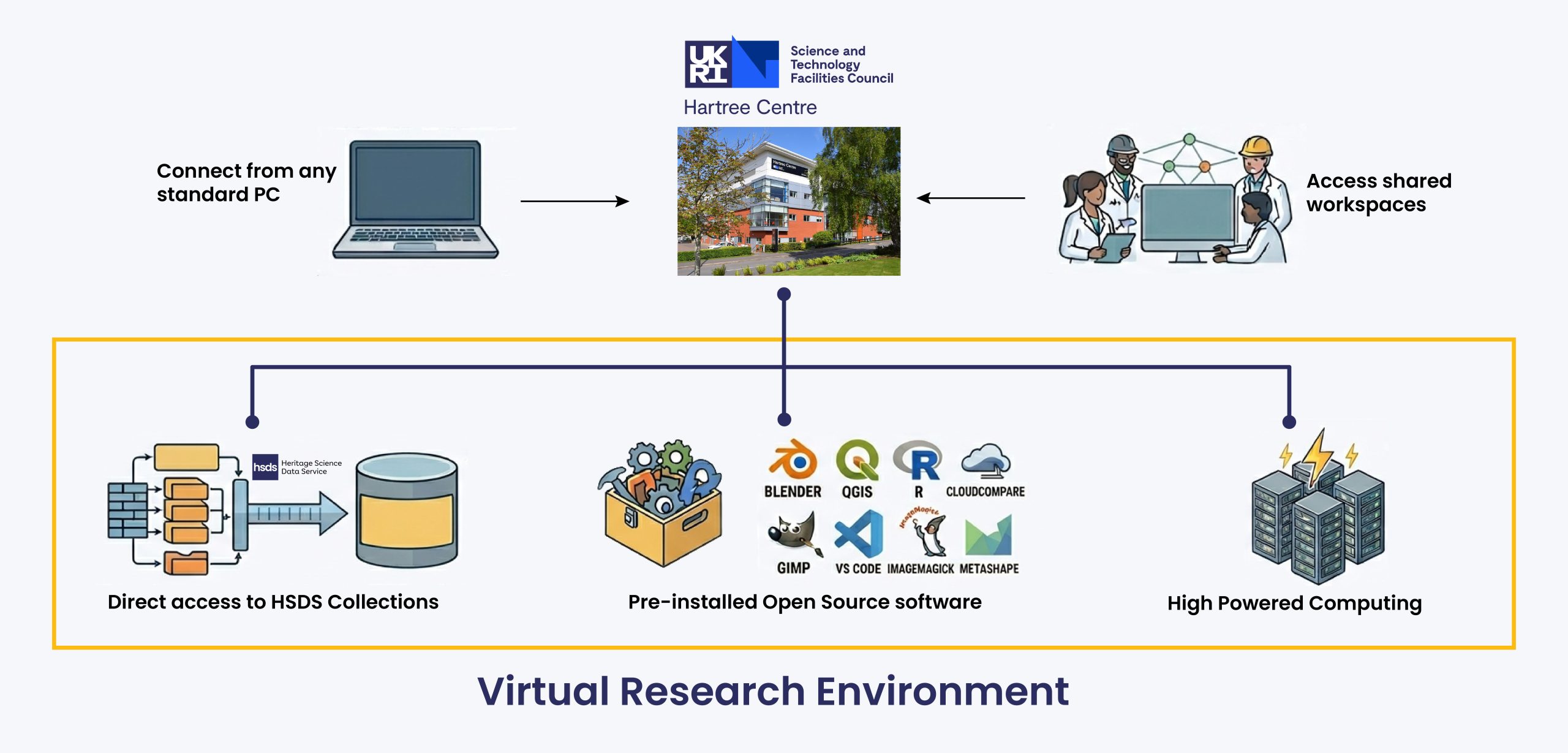
A Virtual Research Environment (VRE) is a secure, custom-built online platform that acts as a central digital workbench for researchers and teams. It provides high-powered computing available virtually through your own PC.
A VRE can be accessed by a single user or be collaborative, allowing specialists and teams from single or multiple institutions to seamlessly analyse, share and visualise their work, making complex research far more efficient.
What does the VRE do?
STFC Hartree Centre has built the VRE to help users bring together tools, and complex and large-scale data into one location.

The platform allows users to launch a high-performance virtual desktop, with access to pre-installed software including:
- Blender
- QGIS
- R (GUI interface)
- CloudCompare
- GIMP
- VS Code
- ImageMagick
- MetaShape
The VRE also allows users to pull in data directly from the HSDS. All HSDS collections can be queried and filtered within the VRE, allowing a user to select those files they want to work with and then quickly load the data into their personal storage area.
The VRE provides personal storage for individual users and shared project storage for collaborating with colleagues.
How can VREs be used?
The VRE can be used in any analysis, visualisation and application where enhanced computing power is needed. The exact use will vary depending on user project aims and data analysed.
For example, a VRE might be built to help a team of structural engineers, conservation scientists, and art historians to study the degradation of a historic building. The VRE hosts the high-resolution 3D models (created via laser scanning or photogrammetry) along with all the analytical data (e.g. environmental monitoring, materials analysis reports, stress simulations). These might be data drawn from different sources, or data that are just too large to manipulate efficiently using standard desktop or laptop computers.
Using the VRE, researchers can enter a virtual space to examine the object or site together in real-time. They can overlay different data layers (like temperature maps, decay rates, or structural diagrams) onto the 3D model, allowing them to pinpoint problem areas and plan an intervention. End-users will be able to customise their own research environment with their own end-user applications and configurations.
You can see further examples of VRE use cases on our Case Studies page.