Last year we were excited to announce the start of the Applying Reactive Twins to Enhance Monument Information Systems (ARTEMIS) project.
Set to run for three years, ARTEMIS will use reactive digital twins to forecast the consequences of real life events, such as deterioration, on cultural heritage. This will allow these events to be addressed and identify and remedy potential damage to cultural heritage before it occurs. The creation of digital twins can also improve visitor experience through immersive encounters with cultural heritage, as well as advancing research and education.
The ADS is involved in multiple work packages within the project, leading work on: Setting up the ARTEMIS digital infrastructure, Infrastructure implementation and infrastructure release . To mark the achievement of one year working on this project, we wanted to highlight some of the amazing work to date!
From Vision to Action
This video tells the story of what the project has achieved so far, from an idea to building the ARTEMIS ontology and creating a community to help us protect heritage across Europe.
CAA Conference 2025
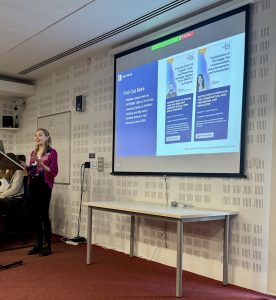
On 9th and 10th December 2025, ADS staff attend the annual conference organised by the British chapter of Computer Applications and Quantitative Methods in Archaeology (CAA-UK). This year’s event was held at the Henry Wellcome Building at the Department of Archaeology, University of Cambridge.
One of the final sessions, New Digital Horizons, highlighted how AI and advanced software are automating archaeological workflows. During this session Dr Sarah Middle, our Postdoctoral Research Associate, discussed the creation of Digital Twins in the context of the ARTEMIS project.
To find out more about CAA 2025 you can read a recent blog post from Marco Brunello.
ARTEMIS Learning Series
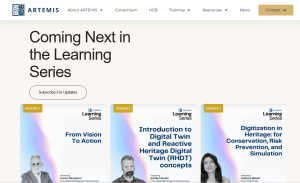
Four episodes of the ARTEMIS Learning Series are now available covering the main concepts of ARTEMIS, project Knowledge Base, the Reactive Heritage Digital Twin model, the strategic role of digital technologies in the conservation and risk management of cultural heritage, and a practical introduction to building semantic and interoperable digital models for Reactive Heritage Digital Twins.
Infrastructure Design and Setup
One of the deliverables from this project led by Dr Sarah Middle and Prof Julian Richards, Infrastructure Design and Setup, is now openly available. The present document aims to define the setup of the ARTEMIS infrastructure, in terms of resources and related services that will be made available for both data and application management.
ARTEMIS Plenary & General Assembly
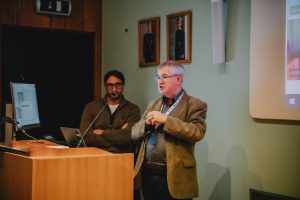
ARTEMIS organised a three day event in December hosted by the Royal Institute for Cultural Heritage in Brussels, Attended by Dr Sarah Middle and Prof Julian Richards. The 15th and 16th of December were devoted to the project members only, with the 17th involving EU representatives and a number of other projects with whom ARTEMIS is collaborating. Julian’s presentation focused on how national infrastructure and investments can interface with European projects, specifically how HSDS fits into the European landscape via E-RIHS.
Latest News & Events
See all
Virtual Research Environments Launch
The Heritage Science Data Service (HSDS) is thrilled to announce the official launch of...
Upcoming Events
We are excited to share that HSDS will be attending a number of conferences...
HSDS Training Hub
The HSDS is thrilled to announce we recently launched our new training hub, a...